
Motorsport · Swansea
Swansea's first full aero package signals a new chapter for Welsh Formula Student
Swansea University Race Engineering's 2026 campaign brought its first full aerodynamic package to the programme, while Cardiff Racing again put Wales among Formula Student's strongest teams at Silverstone.
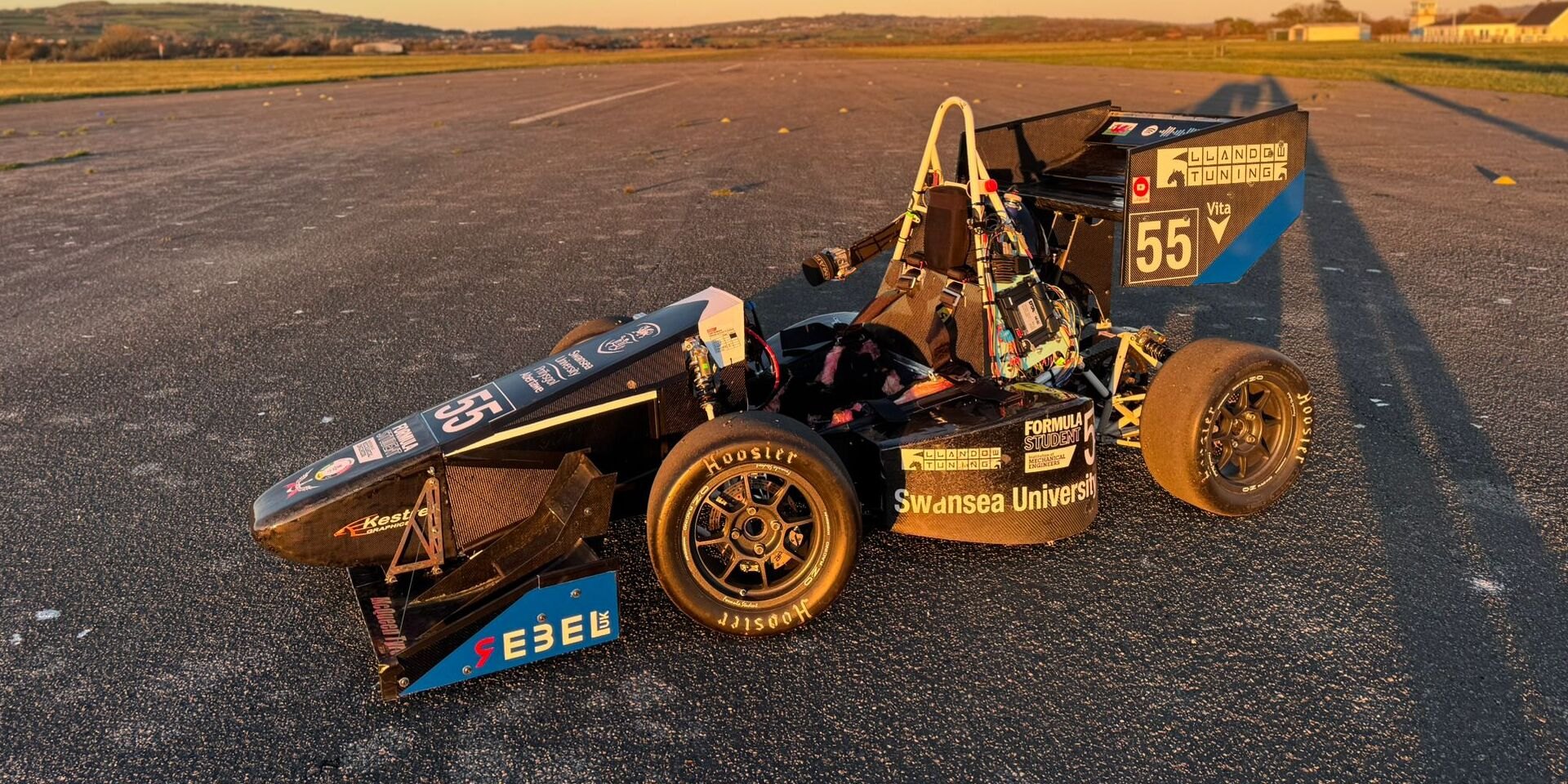
Swansea University Race Engineering arrived at Formula Student 2026 with a development milestone that will mean more to the people who built the car than a single result ever could: for the first time, the team had been able to run a complete aerodynamic package.
SURE has been designing, building and racing its own single-seaters since 2001. That long history makes the aero step all the more telling. The team used its 2025 car at a Pembrey Airfield test day last November to trial the new package, saying it was the first time it had been able to implement one. Its aim was straightforward: produce more downforce, and therefore give the car more grip and stability.
It is a simple sentence that conceals a daunting amount of work. A full aero package does not arrive as a bolt-on performance part. It has to be designed around the car, manufactured within a student team’s resources, fitted safely, and then tested alongside every other system. More grip can mean a quicker car, but it also changes the balance that the driver feels, places different demands on the tyres and suspension, and can add drag. In other words, it creates another set of engineering questions that the students have to learn to answer.
What Formula Student is really testing
Formula Student is sometimes described as university motorsport, but that undersells it. The Institution of Mechanical Engineers competition asks teams to develop a viable small racing-car project, then defend the work in front of industry judges. Before the cars reach the dynamic events, teams face static assessments covering design, cost and manufacturing, and the business presentation. Only then do the cars go through scrutineering and attempt acceleration, skidpad, sprint, endurance and efficiency events.
The structure is deliberate. A quick car with weak engineering, a clever design that cannot be made, or a good business case without a reliable vehicle will not go far. That is why Formula Student has become a serious proving ground for the people who go on to work in motorsport, automotive engineering and related industries. In 2026, more than 100 teams came to Silverstone across combustion, electric and hybrid powertrains.
For SURE, that meant taking the lessons of Pembrey into the intense, unforgiving environment of a Formula Student week. Official results placed car 88 49th overall on 158.4 points. It scored 65 points in the Design event, and its endurance run ended after four laps. That is not the finish the team would have set out to achieve, but it is also a candid part of the process. The important detail is that the team is testing bigger ideas, learning from the result, and building the knowledge that can be carried into the next car.
Support that goes beyond a logo
That progression depends on more than the students themselves. SURE’s partner list includes Easy Composites, Vita, Rapid Harness, DTA, Kestrel Graphics, Proformance Metals, HLP Tube, Entryphone, Gamma Technologies and Airtech Advanced Materials Group. Together, those names reflect the range of disciplines behind any modern student racing car: materials, manufacturing, electronics, data, engine management and presentation.
Llandow Tuning’s contribution is especially hands-on. In April, the Vale of Glamorgan workshop said it worked with the students over about a week to resolve wiring and calibration issues, helping get the car running, changing gear and moving under its own power. The wider technical partnership covers diagnostics, motorsport wiring, sensor integration, ECU configuration, calibration, data logging and controlled testing.
This is the kind of sponsorship that matters when a student-built car reaches the awkward point between being assembled and being ready. A fault can be electrical, mechanical, sensor-related or buried in the calibration; finding it quickly and methodically is as valuable as another expensive component. Llandow describes its role as helping the students move from a symptom, to a test, to an engineering decision. That is precisely the habit Formula Student is intended to teach.
Two Welsh teams, and one fair question
Swansea was not Wales’ only representative at Silverstone. Cardiff Racing, the Cardiff University team, finished 19th overall in the 2026 Formula Student results with 272.3 points. It scored 100 in Design, placing it 14th in that discipline. It is a strong reminder that there is genuine Formula Student depth in Wales — and that the two university teams are working at different stages of their development rather than simply racing one another for local bragging rights.
There is also a Welsh absence worth handling with care. The University of Wales Trinity Saint David does not appear in the IMechE’s preliminary 2026 Formula Student team list or the final 2026 results. Given that its Motorsport Engineering course covers race-vehicle design, vehicle dynamics, aerodynamics and electrical control, that understandably raises eyebrows.
But it would be wrong to suggest UWTSD has no Formula Student connection. It appeared alongside Wuhan University of Technology in the 2025 Formula Student scrutineering queue, and its students have competed in Formula Student Sim Racing. UWTSD also runs Team MCR, a student racing team involved in Sports 2000 competition. The reasons a university prioritises one project over another are for it to explain. Still, from a Welsh motorsport perspective, it is a fair question: should an institution with such a long-standing motorsport programme aim to put a full car back on the main Formula Student grid?
The next chapter
Swansea’s full aero package is not a claim that the job is finished. It is a sign that the work has become more ambitious. The next challenge is to understand how the package behaves, turn the data into better set-up decisions and make the car reliable enough to show its potential across a complete event.
That is how Formula Student earns its reputation. The students do not simply learn about wings, wiring looms, calibration maps or endurance strategy in a lecture. They have to make those things work together, under pressure, in front of judges and on track. Swansea’s first full aero package is therefore a proper landmark — and, more importantly, a promising starting point for what comes next.
Sources and further reading
- Swansea UniFS: first-term 2026 recap
- Formula Student 2026 overall results
- Llandow Tuning’s SURE partnership page
- Formula Student 2026 preliminary team list
Photography: Swansea car 88 on track at Silverstone; students working on car 88 in the garage; and the Swansea University Race Engineering team at Silverstone. Credits on Llandow Tuning's page: Swansea University Race Engineering.
Image use: Images are credited where known and used under licence, permission or an applicable copyright exception. Copyright remains with the relevant holder.
The conversation
Comments
Sign in to comment.